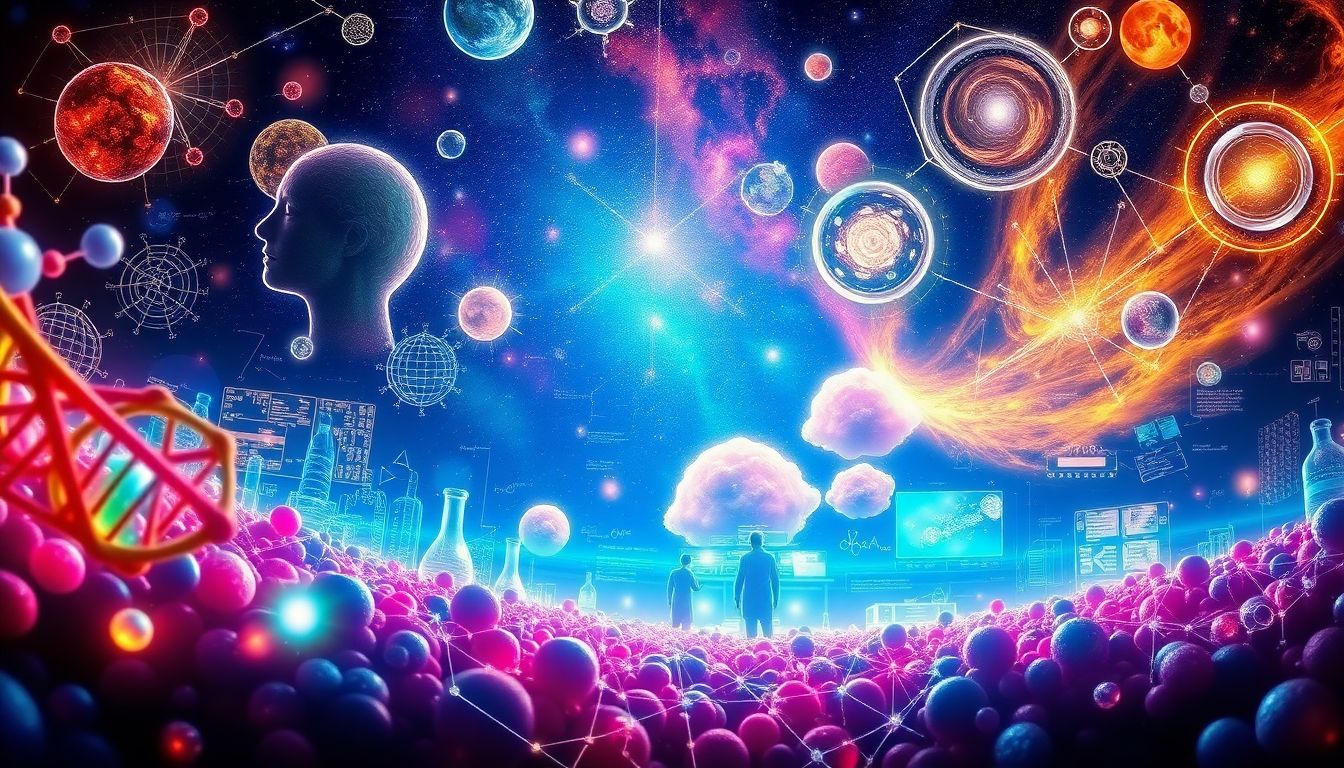
A Journey Through Science: From the Infinitesimal to the Cosmic, Delving into the Principles that Shape Our Universe
Introduction
Imagine looking at the night sky and feeling tiny compared to the vast universe stretching out far beyond. Now, picture zooming in, tiny particles so small they defy imagination, all the way to enormous galaxies millions of light-years away. Science helps us understand this incredible scale. It connects everything from the tiniest sparks of energy to the enormous cosmic dance of galaxies. The laws of nature are the thread that links these worlds. By exploring the basic principles that govern all levels of the universe, we gain a deeper appreciation of where we fit in this grand story. Join me on this journey through scientific discovery, revealing how the universe’s secrets are woven together.
Exploring the Microcosm: Understanding the Infinitesimal
The World of Subatomic Particles
At the smallest scale, particles make up everything we see around us. Quantum mechanics explains how electrons, quarks, and neutrinos behave in strange ways. These tiny building blocks are part of what scientists call the Standard Model, which describes nearly all fundamental particles known today. Researchers use enormous devices like CERN’s Large Hadron Collider to hunt for new particles or understand existing ones better. These experiments help clarify the foundation of matter itself. Without understanding particles, we can’t fully grasp how the universe functions at its core.
Quantum Principles and Uncertainty
Quantum physics isn’t about neat, predictable rules. Instead, it introduces concepts like superposition, where particles can be in multiple states at once. Entanglement links particles so far apart that knowing one tells us about the other instantly. The Heisenberg uncertainty principle says we can’t know both a particle’s position and speed precisely at the same time. These ideas have practical uses, like quantum computers and encrypted messages. Thinkers like Niels Bohr and Richard Feynman described the strange, fascinating world of quantum physics. It challenges our common sense, yet it unlocks new technology.
The Building Blocks of Matter
Atoms are the foundation of all material things. Their structure, made of nuclei and electrons, determines their properties. Advancements in nanotechnology allow us to manipulate structures at a tiny scale, opening new doors for medicine and materials science. For example, scientists create nanomaterials that make stronger, lighter, and more conductive products. Curious learners can explore interactive tools that visualize atomic interactions. These simulations make it easier to see the invisible world of atoms and subatomic particles. Knowing these basics opens the door to all matter’s mysteries.
From Particles to Cells: Connecting the Quantum to Biology

Molecular Machinery and Biochemistry
Quantum physics plays a role even inside living things. Processes like photosynthesis and how enzymes work may depend on quantum effects. Researchers are discovering that quantum entanglement might explain how some animals navigate using Earth’s magnetic field. This emerging field, called quantum biology, shows how tiny quantum phenomena influence large biological systems. These discoveries could lead to breakthroughs in medicine and technology. It’s amazing to think that the same rules governing particles also help life function.
Cellular Complexity
Cells are made of molecules arranged in complex ways. They form tissues, which then make up organs and systems. Microbiology and genomics reveal how cells operate and adapt. For example, CRISPR gene editing technology allows scientists to modify DNA, revolutionizing medicine. Understanding the cellular level helps us combat diseases and develop new treatments. By studying how life adapts at the smallest scale, we learn about our own resilience. Each discovery brings us closer to solving many health puzzles.
The Origins of Life and Molecular Evolution
Scientists believe life started from simple molecules through a process called abiogenesis. Extremophiles—organisms that thrive in harsh environments—show how resilient life can be. Research into early molecular evolution helps explain how living things began. You can stay updated on biotech advances that promise new health solutions. These studies show how life might have emerged and persisted through billions of years. The story of life’s beginnings is a key chapter in understanding our universe.
Navigating the Macrocosm: Our Universe Unveiled
The Formation of Stars and Galaxies
Cosmic evolution began with the Big Bang, about 13.8 billion years ago. After the explosion, matter cooled and clumped, forming stars and galaxies. Telescopes like Hubble and James Webb reveal the universe’s history, showing star birth and galaxy collisions. These observations confirm how the universe has evolved over time. Leaders like Carl Sagan and Neil deGrasse Tyson inspire us to explore these cosmic wonders. They remind us of our place in this vast, ever-changing universe.
The Forces Shaping the Cosmos
Four fundamental forces rule the universe: gravity, electromagnetism, nuclear forces, and the weak force. Gravity keeps planets in orbit and causes galaxies to interact. Electromagnetism powers light, electricity, and magnetism. Nuclear forces govern how atoms fuse inside stars, producing energy. These forces shape everything from tiny atoms to massive galaxy clusters. Scientists estimate that our universe is about 13.8 billion years old, constantly expanding and changing. Understanding these forces helps decode the universe’s structure and future.
Dark Matter and Dark Energy
Most of the universe isn’t visible. Around 95% of it is made of dark matter and dark energy, which we can’t see directly. Dark matter helps hold galaxies together, while dark energy pushes things apart, causing the universe to expand faster. Evidence for their existence is strong, but scientists are still trying to understand what they are. Projects like the Vera C. Rubin Observatory are helping reveal their secrets. Learning more might change how we see the entire cosmos.
Sponsored by:
“This Content Sponsored by Buymote Shopping app
BuyMote E-Shopping Application is One of the Online Shopping App
Now Available on Play Store & App Store (Buymote E-Shopping)
Click Below Link and Install Application: https://buymote.shop/links/0f5993744a9213079a6b53e8
Sponsor Content: #buymote #buymoteeshopping #buymoteonline #buymoteshopping #buymoteapplication”
The Principles Unifying All Scales of Reality

The Laws of Physics and Their Universality
From tiny particles to massive galaxies, the same basic laws apply. Newton’s laws describe how objects move; Einstein’s relativity explains how space and time work at high speeds or in strong gravity. Quantum physics rules the very small, and all of these principles connect in predictable ways. Physicist Stephen Hawking said these laws show the universe has a deep unity. Recognizing this interconnectedness helps scientists develop new theories and explore mysteries like black holes or the origin of everything.
Symmetry and Conservation Laws
Symmetry isn’t just about beauty in art—it’s fundamental in physics. It explains why energy, momentum, and charge stay constant in different situations. These conservation laws allow scientists to predict what might happen in experiments or natural events. For example, knowing energy is conserved helps ensure safety in particle experiments. Symmetry guides the search for new particles and forces. It’s a core idea that keeps our understanding of the universe consistent.
The Future of Scientific Exploration
Scientists are chasing big questions. Quantum gravity theories, string theory, and multiverse ideas push our understanding farther. New technologies promise advances in energy, medicine, and space travel. Stay connected with updates from organizations like NASA or CERN, which lead in scientific discovery. Each breakthrough paves the way for innovations that can change our lives and deepen our understanding of reality.
Conclusion
The universe is a vast and mysterious place, yet its core principles tie everything together. From the tiniest particles to the sprawling galaxies, the laws of physics shape all matter and energy. This connectedness shows how much we have learned—and how much there still is to discover. Science keeps pushing boundaries, revealing new secrets and inspiring curiosity. Understanding these universal principles helps us appreciate our place in this universe, fueling our desire to explore further. The journey from the smallest particles to the grandest cosmos is ongoing—and it’s ours to experience.
 General Explorer